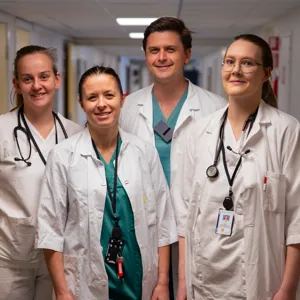
Previously, the first working day for new LIS doctors could be overwhelming, with full operational activity from the very start. One had to navigate through unfamiliar corridors, find access cards, work clothes, and departments, all while beginning the role of a doctor. The situation has now improved, thanks to the mentoring programme.
– We want the new employees to feel part of the community in the division from day one, says Anna Thomassen, LIS and mentoring coordinator for the surgical division at Nordbyhagen.
What does a mentor do?
The mentor will help the new employees quickly become acquainted with both colleagues, systems, and tasks, while the programme facilitates a holistic and inclusive experience upon employment.
The goal is for the doctors to be welcomed better and receive closer follow-up when they start working in a hospital.
– One of the most important aspects of the mentoring programme is that it is the LIS doctors themselves who provide follow-up for the new employees. This creates a lower threshold for asking questions and seeking help, as there is no fear of showing vulnerability to management, says Karen Regine Finnsdotter Rye, LIS doctor and mentoring coordinator for the medical division at Nordbyhagen.
– There is much that is obvious to us who have been here for a while, but the newcomers do not know where the coffee, clothes, or meeting point are, so it is nice to welcome them and give them an introduction, says Anujan Muthiah, mentor in internal medicine at Ahus Nordbyhagen.
Thank you so much for such a lovely and warm welcome this week! I feel I have been received so well and that I have had a safe and good start with you. I really appreciate it!
The mentoring programme consists of four parts
- Information about the programme is given to the new doctor two weeks before starting.
- The mentor accompanies the new doctor throughout the entire first working day.
- Follow-up occurs after two weeks.
- Further contact is maintained after six months.
The programme is adapted to local conditions and is managed by a mentoring coordinator LIS, along with experienced LIS mentors. It provides new doctors with a lower threshold for asking questions and ensures structured and good training. At the same time, it does not relieve leaders or union representatives but serves as a supplement to existing support systems.
Local adaptations
Ahus is a large enterprise, and the various divisions and departments are structured somewhat differently. At Ahus Kongsvinger, they have merged the mentoring programme between medicine, surgery, and orthopaedics.
– Since Kongsvinger is a smaller hospital, there are fewer others to rely on, and the LIS doctors must prepare to be on their own quite early, says mentoring coordinator Joanna Lankut.
– Many new LIS3 may find it tough to come here. In larger hospitals, there are many on duty at the same time, so you always have someone to bounce ideas off. Here, one is alone on duty quite early, so it is especially important to have a mentoring programme that prepares the LIS for that. We are also very keen that none of the new LIS doctors should work alone during their first two to three weeks, says Joanna.
Divisions and departments involved in the mentoring programme
- Medical division, Ahus Nordbyhagen
- Surgical division, Ahus Nordbyhagen
- Joint programme for medicine, surgery, and orthopaedics, Kongsvinger hospital
Separate programme in the orthopaedic clinic
The orthopaedic clinic at Ahus Nordbyhagen has its own mentoring programme for its 30 LIS3 employees. Each new LIS3 is assigned a mentor who is the same person they will have as their regular night shift partner, making this a natural sparring partner for advice and guidance. The immediate supervisor follows up with the new employees through a conversation after a few weeks. New employees receive tailored service and training during the first two weeks, during which they shadow another LIS3 to learn logistics and routines.